


First Szamotuły
Sansational discovery of the first Szamotuły
It is the discovery on the European scale. Archeologists found the first Szamotuły, situated about 2 km from the present town. The medieval town, called colloquially Old Szamotuły, is located between Szczuczyn and Mutowo. Using aerial archeology, the historians were searching for a church but found a town dated back to the 13th century. It was in Szamotuły, where the Association of Collectors of Domestic Antiquities, the first archaeological society in Poland, started its activities in 1840. Members of this organization did the first research in the vicinity of Szczuczyn, as it was the place of probable location of a trade settlement. Unfortunately, none of the archeological groups managed to find it. New archeological techniques revolutionized the exploration in 2006. Archeologists used aerial photography, geophysics, and examined local plants. These photos are sensational as we had been looking for a village or a church and found the town, former Szamotuły - said professor Włodzimierz Raczkowski from Adam Mickiewicz University in Poznan.
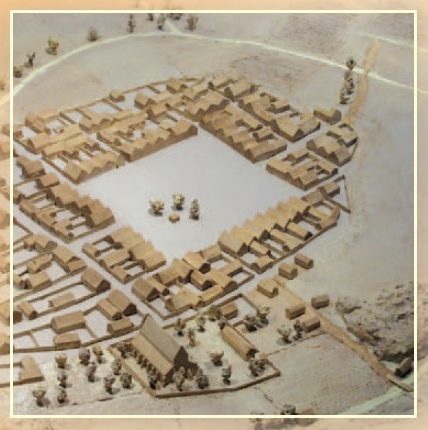
It was known that the neighborhood hides the settlement, which was granted market rights in 1257. St. Martin Church was probably constructed in this place in the 11th century. Surprised archeologists recognized a medieval market in the aerial photographs. They saw a town on a square plan (75 m long sides) with shapes of huts, fronts facing the market in the middle. Each frontage has seven plots and each plot is 10 to 22 meters long. They are sharply divided into residential part and farming extension. This layout is repeated in the present architecture of the town, in plans prepared in 1928 for Szamotuły.
An undefined object is situated in the middle of the market. It can be a construction of a town hall or a weigh house. The market was probably covered with cobble stone. Professor Włodzimierz Raczkowski notices with amazement that there is a visible fence or a passing at one of the huts. The research shows that the discovered town was not fully developed.
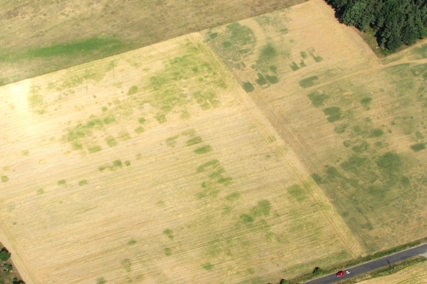 The market was surrounded by dense development as it was the most valuable location; the number of houses decreases further from the market. It is fascinating that the layout of streets is repeated in the old town of the present Szamotuły. It may mean that the constructors of the present Szamotuły remembered the pattern of the old settlement. Why did they create a new town? What happened with the old town? The archeological research reveals a big amount of ashes. The town most probably burnt, maybe during the devastating civil war between Nałecz and Grzymalita families. For the better protection, the new town was located in the territory surrounded by swamps. There is a street leading from the discovered town towards the south. It might be the direction of the still hidden settlement… According to professor Raczkowski, the results of the studies are unique on the European scale, as it is the only archeological site of this type in Europe. It is interesting that so much information comes from the analysis, without the need of digging. All the outcomes are based on aerial photography, geophysics and the historical knowledge. The drought in spring 2006 also contributed to the results of research as the plants outlined the plan of the old city.
