


Architectural treasures - heritage in good hands
Architectural treasures - heritage in good hands
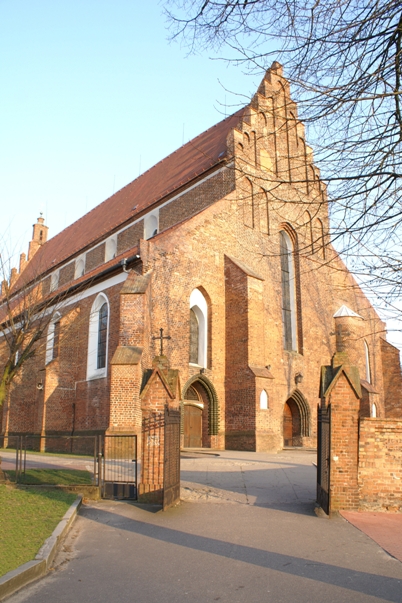
MINOR BASILICA
Minor Basilica - the former Collegiate Church of Blessed Virgin Mary Mother of Consolation and St. Stanislaus the Bishop is the oldest monument in the town and also one of the most important ecclesiastical architectural objects in Wielkopolska. The one-nave church in the vicinity of the market was erected in 1423-1431. Since the 16th century the church was enlarged by two aisles, topped with the roof decorated with a flèche. The star-vault, which is characteristic for German Gothic, gives the building a monumental and spacious character. The walls and the windows are decorated with interesting polychromes and stained-glass from the 19th and 20th century. The crucifix decorating the rood beam, one of the oldest in Wielkopolska (about 1370) should be recommended to admire. Late-renaissance stone tomb of Jakub Rokosowski from the workshop of Canavasi is located in the nave, next to the presbytery. One of the most interesting and unique monuments in the church in Szamotuły is a bronze gravestone of Andrzej Szamotulski from about 1500, made in the workshop of Andreas Vischer. A stone baptismal font from the 16th century is also worth mentioning. The presbytery is filled with a baroque altar with a few precious paintings and two abundantly adorned side alters. The southern nave hides a copy of a baroque alter with amiraculous painting of the Our Lady of Consolation from Szamotuły. It is a Russian icon from the first half of the 17th century. For centuries this picture has been an object of religious worship and the destination of numerous pilgrimages.  In 1975 the image of Madonna was crowned with papal crowns by Cardinal Stefan Wyszynski, the Primate of the Millennium. In front of the church one can find a gate – a neo-gothic belfry from the second half of the 19th century with a late baroque crucifix from the third quarter of the 17th century. In May 2008, Cardinal Stanisław Dziwisz, according to the will of John Paul II, passed the relics of St. Stanislaus for the then Collegiate. On 13th May 2014 the church was designated to minor basilica by a decree of Pope Francis. At the same time the temple was enriched with the first class relics of St. John Paul II. First class relics are made of parts of body of the saint. Basilica in Szamotuły possesses a blood drop of John Paul II.
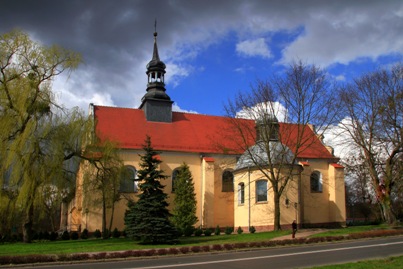
THE BAROQUE CHURCH OF THE HOLY CROSS – FRANCISCAN MONASTERY
On the banks of the Sama River, in the so called Poznan suburbs, one can find the Holy Cross Church and a monastery, erected by Korzbok-Łaccy family in 1667-1682. In about 1300 it was a location of Swidwa-Szamotulscy Castle. It was a heart of the originating town. The gothic walls of the Swidwa fortress were adapted to religious purposes. The church and the monastery were a property of the Reformed Franciscans. In 1809 the monastery was liquidated by the Prussian authorities, who took over the properties and gave them to the Prussian national treasure. The building regained its religious function in about 1966. The monastery was not returned to the Franciscans but its living space was turned into a residential area. At present, the chapter-house, refectory and a dormitory are used for cultural purposes. The gable roof of the one-nave church is topped by a baroque turret with a bulb helmet. The interior is covered by a barrel vault with characteristic skylights. The ceiling is adorned with the contemporary polychromes depicting the Passion. The octagonal chapel, covered by the dome with a skylight, is adjoined to the nave from the east. The inside of the dome is decorated with the scenes from the life of St. Antony, painted in the 17th century. Rococo furnishings inside the church and the main altar are dated back to about 1760 and were created in the workshop of Józef Eglauer. The main altar with a crucifix, figures of Painful Mary, St. John the Baptist, two monks and the images of God the Father, Holy Spirit and angels are the main element of the church. Attention is drawn by late rococo carvings of the pulpit, altar stone,pews, baptismal font and a confessionals made by Eglauer.
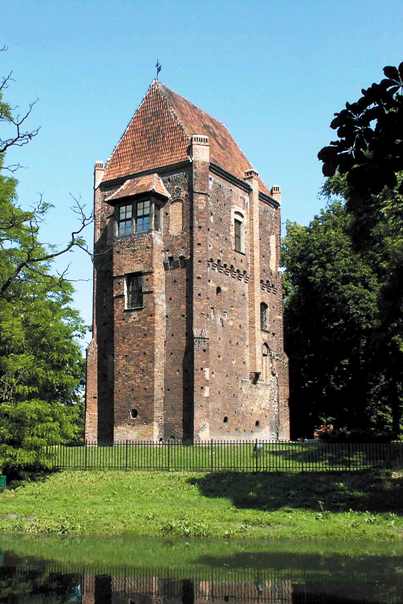
THE CASTLE AND THE TOWER
In the northern part of the town, in the so called Wronki suburbs, one can find a castle from the end of the 15th century, constructed by Dobrogost Swidwa Szamotulski and rebuilt in 1513-1518 by Łukasz II Górka, who gave his name to the it. The castle had numerous owners who altered the architecture many times. The castle definitively lost its gothic character about 1870, during the redecoration initiated by the then owners, the Sachsen Coburg Gotta ducal family. At present it is a location of the Museum – Górka Castle. The Museum consists of late gothic tower, called according to the tradition, the Halszka Tower or the Tower of the Black Princess. The tower got its name as a result of numerous tragic events connected with the life of a Wołyn princess, Elżbieta from Ostroróg, who was a wife of Łukasz III Górka. Tourists can visit the exhibition depicting the history of Szamotuły and its neighborhood, located in the tower. Next to the castle, there are 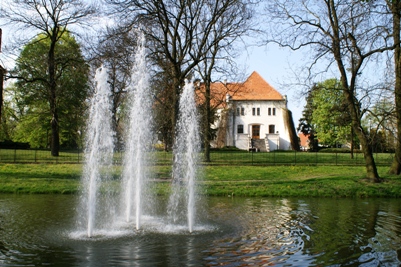 two outhouses from the end of the 18th century. Inside one can find the ethnographic exhibition illustrating the furnishings of a hut from Wielkopolska and craftsmen’s workshops. Inside the castle there are permanent exhibitions; well-arranged interior of a gentry house with numerous artistic exhibits: paintings, furniture, coins, clocks, fabrics etc. A collection of Orthodox and Uniate icons requires special attention.
In one of the Museum’s rooms tourists can admire a collection of Orthodox and Uniate icons. It is one of the biggest and artistically diverse collections in Poland. It consists of almost 1200 wooden works dated back mainly to the 19th century. The Museum – Górka Castle is a prize winner of the second edition of the competition Tourist Pearls of Wielkopolska, in the category – a tourist attraction.
